
Danish education levels
This page explains the education levels you may find in our general assessments of non-Danish qualifications.
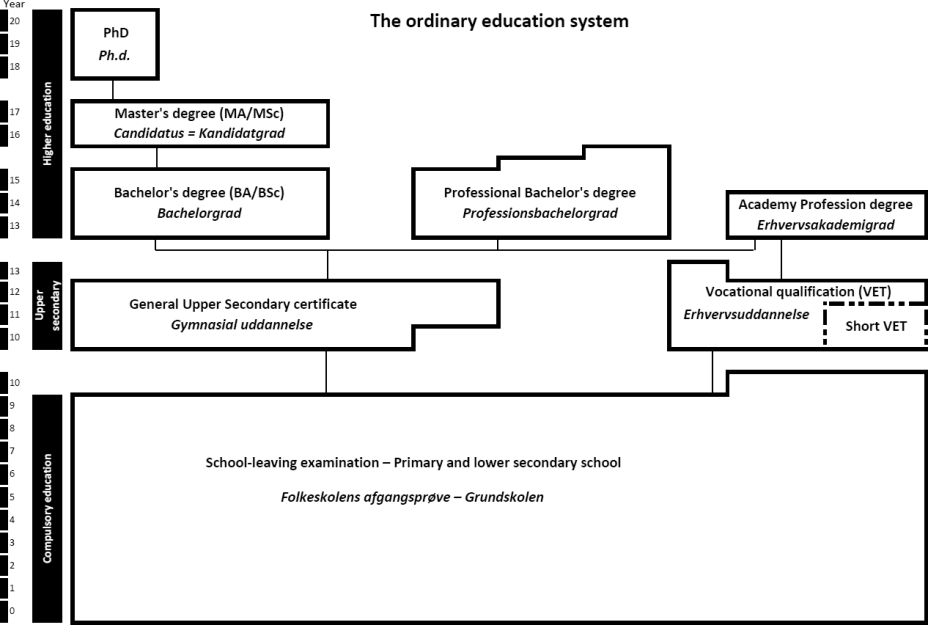
Upper secondary qualification
Upper secondary qualifications include general upper secondary qualifications and vocational qualifications.
General upper secondary qualification
The general upper secondary programmes are academically oriented and theoretically based.
There are four main qualifications:
- Higher General Examination (stx, 3 years)
- Higher Technical Examination (htx, 3 years)
- Higher Commercial Examination (hhx, 3 years)
- Higher Preparatory Examination (hf, 2 years)
Stx, htx and hhx give access to higher education.
Hf including additional courses also gives access to higher education.
Hf without additional courses gives access to Academy Profession programmes and Professional Bachelor's programmes, but need supplementary courses to qualify for university Bachelor's programmes.
Vocational qualification
Vocational qualifications are obtained through vocational education and training (VET). The VET programmes prepare learners for work in specific trades and crafts. They alternate between school-based teaching and internship in a public or private enterprise.
VET programmes vary in length, and some can be completed at various stages.
Vocational qualifications based on VET programmes of at least 3 years provide access to academy profession programmes.
The assessment "a vocational qualification" indicates a level corresponding to a Danish VET qualification of 3 years or more.
The assessment "a short vocational qualification" indicates a level corresponding to a Danish VET qualification of less than 3 years.
Higher education qualifications
Academy profession degree
Academy profession (AP) programmes are short-cycle higher education programmes combining theoretical knowledge with practical challenges. In order to be admitted to these programmes, you need a general upper secondary qualification or a vocational qualification of at least 3 years.
Most academy profession programmes take 2 years to complete (120 ECTS).
AP graduates can take up employment. In some fields, they can apply for professional bachelor's top-up programme.
Professional bachelor’s degree
The professional bachelor's programmes consist of a combination of theory and practice and normally take 3 ½ years to complete (210 ECTS). The practical education is in the form of work-experience at a workplace and covers approximately 6 months in total.
Professional bachelors can take up employment or, in many cases, enter a master's degree programme.
Bachelor’s degree
Bachelor's programmes are research-based programmes offered by universities. The programmes take 3 years to complete (180 ECTS).
A bachelor's degree qualifies students for admission to a master's programme.
Master’s degree
Master’s programmes are research-based programmes offered by universities. A relevant bachelor's degree is required. The programmes normally take 2 years to complete.
A master's degree qualifies graduates to apply for a research position and enter a PhD programme.
PhD degree
The PhD degree is normally awarded after three years of higher education and research (180 ECTS) following a Master’s degree.
The PhD degree (Danish: ph.d.-grad) is awarded after a total of normally 8 years of higher education and research. The PhD programme itself normally takes 3 years (180 ECTS points).
The standard entry requirement is a Master's degree (MA, MSc, etc.).
Learn more about the Danish education system